Why most adoption stalls, the stages that actually work, and a real firm that walked the whole path.
Fifteen years in enterprise sales and go-to-market — including advisory work at Gartner across 400+ executive sessions, and execution roles at Scandit, Zowie and Droppe.
The four stages you'll see today, and the reasoning for their order, were designed before they ever met a company. They then spent a year being proven inside a real engineering firm — a full AI transformation, run end to end. That company is the one we walk today.
The pilot works in the demo. It never becomes the company.
Billions invested; no P&L impact anyone can point to.
After the licenses, after the trainings — this is what adoption actually looks like.
Everyone is "doing AI." Almost nobody's company has changed.
Whatever companies have been doing isn't working. So start with what's actually changing.
They already use AI — on you.
Not better than you — built differently.
From doing the task to directing the work.
For the first time, the interface is language.
Often built by an external partner. The pilot impresses. And the company around the automated piece keeps working exactly as before.
Access is not capability. A few enthusiasts run with it; for everyone else the old way of working wins by Friday — and usage quietly fades.
Three years of results say both are missing something. Let's take them apart, one at a time.
Feeding work in the way it always has.
The pilot works. The demo impresses.
Absorbing the output the way it always has.
The business moves at the speed of its slowest part. That's why one improved piece, measured honestly, shows almost no return.
How the car works, what the controls do, the rules of the road.
Controlled conditions. Mistakes get corrected before they cost anything.
Real conditions. You start learning from your own experience.
Driving is second nature. Skill compounds from here.
Every capability you've ever acquired followed these four steps. No one skips them. Organisations learn the same way — they're made of people.
The base competences that let people change. Nobody builds them.
A pilot somewhere. An automation built where it was easiest.
Demanded from a capability nobody has built yet.
It only ever grows out of the steps before it.
Stuck pilots aren't a technology failure. They're what skipping step one looks like.
Understanding what's happening, then building competence, then building solutions — that's how anything is learned. Companies started at step three.
External partners implement and leave. The company gets a solution — and none of the capability. The skill walks out the door with the invoice.
70% of the transformation effort belongs in people and processes — the market has said so for years. It still gets a fraction of the attention.
Low adoption isn't a mystery. It's the predictable result of skipping the part where people learn.
Replacing labour. But cheap execution is available to every competitor at the same price — it's becoming a commodity floor, not an advantage.
When labour stops mattering, skill is the only variable left in the equation — knowing what to build, what good looks like, what's worth doing at all.
The return on automation is capped at the cost of the work it replaces. The return on capability compounds. That's why this is a people programme, not a tooling project.
Build competence before you demand value from it. What follows is the path — four stages, plus the one that makes the others possible — walked with a real company at every step.
Contract engineering for construction and infrastructure — airports, museums, roads, rail, energy. Where we started:
Experts in supervision and contract management. Plenty of work still living in binders.
Not one technical person on staff — IT was an external license firm.
The actual words in the room at the first workshop.
A single mistake in an offer can lose a multi-million contract.
If it works from this starting point, it works from yours.
Real time, carved out — to lead it, and to learn what's actually happening. Not a side task.
Events, peers, information online — how the business world is changing, how it hits your market and each side of the organisation.
Understand your own organisation deeply — the people, the processes they own, where work hurts.
First to really understand the new tools — what they make possible, where their limits are. Genuinely good at one of them.
Build the enablement team, coordinate the champions, report progress, value and challenges to the board — a proper transformation programme.
At ECM, this stage wasn't run — this person was me. Your company needs its own.
The lead needs the board — especially the CEO — visibly behind them. When the whole company sees it matters at the top, following is easy.
It has to be someone who genuinely wants this — naturally curious about AI. Appointed-but-unconvinced doesn't work.
Learning, guiding, catering to people's needs — different paces, different fears, different reasons to resist. Human-focused, not technical.
Foundational workshops for every tier — all 20 people through them, run by the lead.
"My fear grew today — but next to it, a fascination was born." Jobs, careers, what to tell your kids — addressed, not avoided.
Everyone starts working with an LLM — on real work, not exercises.
Leadership sets near-term goals and two governance principles — enough to act.
16 of 20 people working with AI regularly — some daily, some weekly — and the pace keeps picking up.
We started in the summer — holidays stretched the gap between workshop and practice, and hard-won motivation leaked away. Run groups in parallel; keep the pace.
People have their day jobs. Don't push too hard — but don't let the learning time quietly vanish either.
Help the slower, give the faster space — they'll pull the rest. The herd moves at the pace of its slowest member.
"The value comes later," said in advance, still didn't prevent frustration. Keep communicating anyway — and keep it honest.
People fear making a mistake with a tool they don't know. Clear guidelines and real training take that fear away — it's not just for the board.
The core process mapped — from finding tenders to closing the contract — the interviews filling in the details.
First assistants, deep mapping — and from outside, "nothing is happening." Management sees no value yet.
A multi-million tender lost to one mistake in an offer — despite three people checking it.
The team builds an assistant that checks every offer before submission — without asking permission first.
Power users build for others — the fleet app, the personnel database. Advanced solutions, on the back of the process map.
Process mapping takes time. The good news: AI is far better at it now — whatever feels slow today will be faster tomorrow.
Six months in, the board was losing patience — and when the board loses patience, people lose motivation: "my boss will be mad I spent time on this."
People keep the work they love — and there, AI's value is quality, not replacement. That's the offer checker.
Nobody ended up with less work — there's always more. But higher quality meant visibly less stress.
The fleet app was never used — small fleet, Excel was fine. Not wasted, though: it's how the future lead learned to build apps.

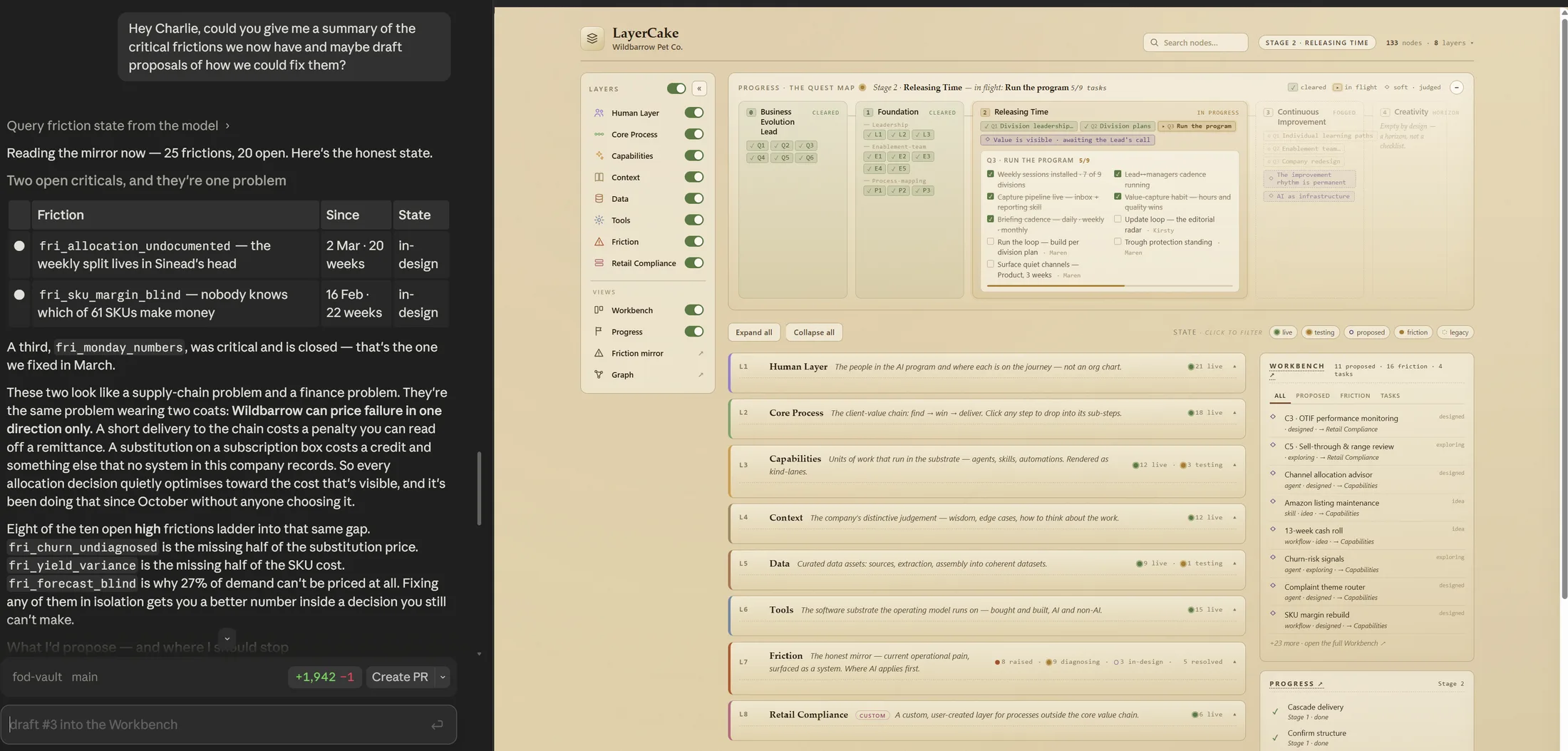
A weekly improvement rhythm — the process that keeps the whole thing moving, and getting better every week.
Learning time carved into every week — before recovered capacity gets absorbed.
The processes stay — tenders dictate them. How they run is rebuilt: information and data flows rearranged, AI as the platform underneath.
Michał — the internal successor, built through the journey — now leads the company's continued evolution.
A team that finds problems, solves them, and looks for new ways to deliver value.
A €50,000 RAG-system quote, answered with Excel and a folder structure — it does the job really well. Startup pitches matched by in-house builds: ~€750/month saved.
Without weekly habits and installed processes, the transformation stalls before the value arrives. Part of the recovered time must become mandatory grow-with-AI time.
At 80% adoption everyone builds, proposes, changes things. You need a way to submit ideas, track progress, assign ownership — it can't stay one person's job.
Context updated, tools added, processes changed — all of it recorded and documented, or the whole thing becomes uncontrollable.
Execution is increasingly carried by the capabilities the company built. What's left for humans is the work that was always the point — and there's finally capacity for it. New products, new markets, ideas that were always there but never had room to breathe.
Noticing the opportunity, the unmet need, the question nobody asked.
Judgment, taste, and the trade-offs only someone who owns the outcome can make.
Purpose surfaces from the work — ambitions grounded in capability the company actually has.
The value you get from AI is directly correlated with the mindset to grow. Automation and efficiency are the floor — the real value is new competitive advantage, new markets, changing the rules of your own. That only happens if senior leadership has the mindset, and the space, to grow.
We won't pretend to describe this stage in detail. The companies arriving there are writing it.
of the company working with AI — in a firm that started at "robot" and "fear."
of tender risk from human error — now guarded by an offer checker the team built itself, in 48 hours.
multi-million contracts with full project reporting — a live view that simply didn't exist before.
the vendor quote for a personnel database — its own people built it instead, and own it.
Nobody wants to be replaced — and it turns out nobody wants to be idle either. People want to be amplified: ownership, learning and thinking stayed human, by choice.
The years-old resignation flipped into: "it doesn't have to be this way — and we have the means to change it." That sentence is the transformation.
Problems that anchored the company for years — too complex, too expensive, too labour-intensive to touch — became solvable by its own people.
No revenue theatre — this is what early value honestly looks like: capability, speed, and a company that keeps improving itself. And it compounds from here.
Every filled layer makes the next build cheaper. That's why the curve bends — and why evaluating mid-Stage-2 is how transformations get cancelled a quarter before they pay.
Polish or English — chat or voice. Describe your company's situation and we'll place it on the map, live.
01 — AI beyond the gated, in-tenant kind (MS Copilot) — how did ECM approach it?
02 — security, data processing, and keeping costs under control.
03 — board-level governance and liability, when agents start to multiply.