A course or two, maybe more. You're well past the basics — perhaps a Claude Code setup, your own second brain, workflows that genuinely carry your day. You're ahead of almost everyone around you. Yet you still feel like you're behind.
the pilots
You've tried things in the company.
A pilot here, something more ambitious there. Some of it works, some quietly died. And even where it works, it's genuinely hard to say where the value is — or how you'd prove it to anyone.
and stuck
But you can't scale it.
What works brilliantly for you doesn't spread. You're not sure how to teach the other fifty people to do the same things — how to set up their tools, how to help them use AI daily in a way that actually supports their work, and how to build a whole operating system around it.
the weight
And you're the one who's supposed to know.
You're the AI person now. The company looks at you for the plan — and the map you're supposed to be holding doesn't exist anywhere you've looked.
section: the_noise
Meanwhile, out there
The market is shouting two things at once.
what the front-runners say
"Productivity through the roof. We'll never work the old way again."
Startups moving at a speed that shouldn't be possible. Teams claiming ten times the output. Every week, another story of a company running on a fraction of the usual headcount.
what the studies say
"95% of companies see no measurable return on AI."
Pilots that never scale. Tools bought and barely used. The gap between what the technology can clearly do and what most companies actually get from it — enormous, and well documented.
the decisions you're supposed to make
new models every monthopen source vs closedon-premise vs cloudvendor lock-inbuy vs buildagentssecuritydata privacypricing that changes quarterlytools launching daily
and the noise you're supposed to think past
"everyone will lose their job""no one will lose their job""AI will take over the world""AI will create abundance"a flood of hot takesAI slop everywherea new "game-changer" every weekAGI next year — or nevereveryone's suddenly an expert
and the advice you get
"Have an AI strategy."
"Set up governance."
"Get the CEO involved."
"Build context."
"Redesign your processes."
"Rethink how you create value."
"Fix your data first."
"Start with quick wins."
"Upskill your people."
All true. Increasingly even specific. And still none of it comes with the how — nobody tells you what to actually do on Monday.
section: whats_different
The thing most approaches miss
This shift hits the whole business at once — at speed.
Previous waves changed one thing at a time: a department, a channel, a system. This one moves everything simultaneously — on three levels. Click anything.
level_01 — the business around you
01+
Your customers are changing
They already use AI — on you.
02+
Your competitors are changing
Not better than you — built differently.
level_02 — every function inside it
03·1+
Sales
03·2+
Marketing
03·3+
Operations
03·4+
Finance
03·5+
People & HR
03·6+
Customer Service
03·7+
Legal & Contracts
03·8+
Leadership
level_03 — the work itself
04+
How work is done is changing
From doing the task to directing the work.
05+
How people meet technology is changing
For the first time, the interface is language.
section: this_is_normal
Before you blame yourself
This is what every real shift looks like — before it gets standardised.
A new capability arrives. There's a messy stretch where everyone can see the power but nobody can say how it fits into a business. Then someone writes down the method, the method gets taught, and it proliferates. It has happened this way every time.
the shift
the messy years
the method appears
then the industry around it
Manufacturing quality~40 years to a named standard
Decades of scattered practice — Toyota quietly building its system from the 1950s on.
Six Sigma, 1986. "Lean" gets its name in 1990 — the method finally written down.
Belts, certifications, a global consulting and training industry.
Software delivery~30 years from crisis to standard
The "software crisis" named in 1968 — decades of late, over-budget, failing projects.
The Agile Manifesto, 2001 — seventeen practitioners at a ski lodge.
Jira (2002), Scrum certifications, an entire agile industry.
B2B sales~20 years of codification
Complex selling grows through the '80s and '90s — every team improvising its own way.
Salesforce (1999), HubSpot (2006), the sales enablement market.
Running a company on AIyou are here
The power is obvious. The pilots are everywhere. The confusion is universal.
The method hasn't appeared yet — this is the gap you're standing in.
Not built yet. You're early, not late.
We are at the moment where the method is needed — and hasn't appeared yet.
The friction you feel is that gap. It is not your failing, and it is not your company's. The biggest names in the industry publish checklists of the destination and admit, more or less openly, that nobody has the sequence yet.
section: the_options
What's on offer
So you look at the options on the table.
option_01 — piece it together yourself
The default — and it doesn't compound
A few licences, a pilot, someone sent on a course, an automation wired up where it was easiest. It's what almost every company is doing, and it isn't a strategy — it's a collection. Each piece is real. None of them makes the next one easier, and nothing in it changes how the company works.
option_02 — online training
Too shallow for the job
Courses teach single use cases and personal productivity — prompt tricks, one tool, one workflow. Useful, and you've done it. None of it explains how to build an AI-native operating system across a whole company. That was never what a course could carry.
option_03 — consulting
Expensive, slow, and it leaves
Mostly it doesn't attempt the real change either. Where it does, it takes months, costs what a small company can't pay, doesn't scale past the engagement — and the capability walks out with the invoice. You get deliverables. You don't get a company that can do this itself.
adding it up
You're trying to change how your company operates. Nobody can tell you the sequence. The resources are scattered, chaotic, and changing monthly. The complexity is real, the talent that could help is scarce and priced for enterprises — and the clock runs either way.
The market has said it for years: 70% of AI transformation is people and process. Then it sells you a tool rollout.
The approaches on offer chase a quarter's ROI and the hype cycle — short-term thinking aimed at a foundational change. It has never worked in any previous shift, and it is visibly not working in this one. A change that touches everything needs foundations, sequence, and time — not a pilot with a press release.
section: the_systemfutureorg_system — v1
This is the exact problem FutureOrg Design was built to solve.
The FutureOrg System
Every domain leader who has ever built a new capability needed the same three things: the knowledge, the tools, and someone who teaches them to apply both in the real world. That is precisely what this is.
the handbook
The Methodology
The knowledge: what has to happen, in what order, and why — a staged roadmap from where you are to an AI-native company that improves itself.
the workshop
LayerCake
The tools: your company made visible — a live model of people, processes, and systems that you build in, and redesign from.
the mentor
Charlie
The teacher: an AI guide in your environment, trained on the method, working through every stage of it with you.
It follows how humans actually learn and change habits — foundation, controlled practice, real application, mastery — because a company is people, and it learns, builds capabilities, and installs new habits exactly the same way, collectively.
It was designed on that principle, backed by the data, then installed in a real company and tested for twelve months before it became a product.
the journey — walk it left to right · click any step
0
stage_00 — preparing_the_lead
Preparing the Lead
The change starts in one person. Before the company moves, its lead gets ready — deliberately.
0 · 1+
Meet your guide
Charlie, and the whole map
0 · 2+
Discovery
your company, learned
0 · 3+
Foundations
how this really works
0 · 4+
The method
the four stages, in depth
0 · 5+
First mapping
your first process, mapped
0 · 6+
Maturity report
the honest baseline
1
stage_01 — foundation_building
Foundation Building
The shared knowledge, mindset, and language without which everything after fails.
1 · 1+
Workshops for every tier
everyone hears it, in order
1 · 2+
Leadership alignment
goals, and one voice
1 · 3+
Light governance
a few clear principles
1 · 4+
An enablement team
peers, not mandates
1 · 5+
Everyone working with AI
real work, daily
1 · 6+
Process mapping begins
the model starts here
2
stage_02 — releasing_time
Releasing Time
People build solutions that take work away from them. Capacity comes back.
2 · 1+
Map your own processes
the real process, not the doc
2 · 2+
Build the first solutions
assistants, skills, automations
2 · 3+
Recover capacity
hours come back
2 · 4+
Reinvest it deliberately
before the calendar eats it
2 · 5+
The dip — named in advance
expected, and survivable
3
stage_03 — continuous_improvement
Continuous Improvement
The destination: improving itself becomes the company's permanent operating mode.
3 · 1+
Weekly improvement rhythm
ideas → built → measured
3 · 2+
Protected learning time
scheduled, defended
3 · 3+
Improvement as part of the job
recognised, repeated
3 · 4+
The company redesign
grounded, not theoretical
4
stage_04 — creativity_explosion
Creativity Explosion
Emerges — not engineered — when stage three runs well.
4 · 1+
Execution carried by what you built
your systems do the grind
4 · 2+
People on discovery & direction
judgment, design, relationships
4 · 3+
New products & markets
growth, not just efficiency
starta continuous improvement company
what it gives you
Control. The roadmap puts you in charge of how the company is evolving — you know where the company is, where it's going, and why. And it carries you to the point where redesigning the company is something you can actually do.
where it takes you
A continuous improvement company: people focus on ideas — how to fix problems, what to build to help the business grow. People have time to learn and develop in their own domains. And AI is the tool that helps them get better.
As the program moves, complexity grows. More people building, more pilots running, more processes touched. Data, context, feedback, decisions — an AI-native company has many moving parts, and they multiply exactly when things start working.
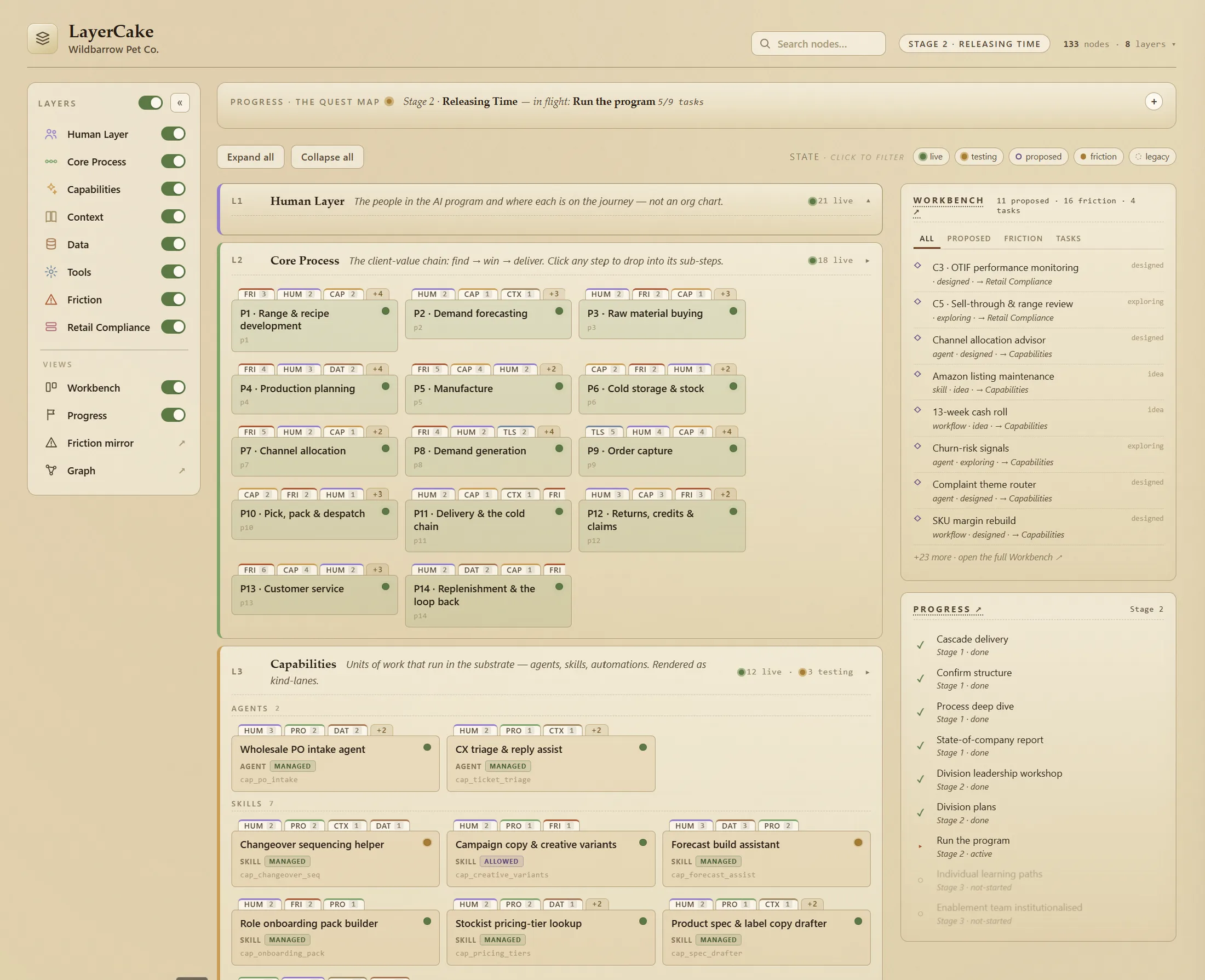
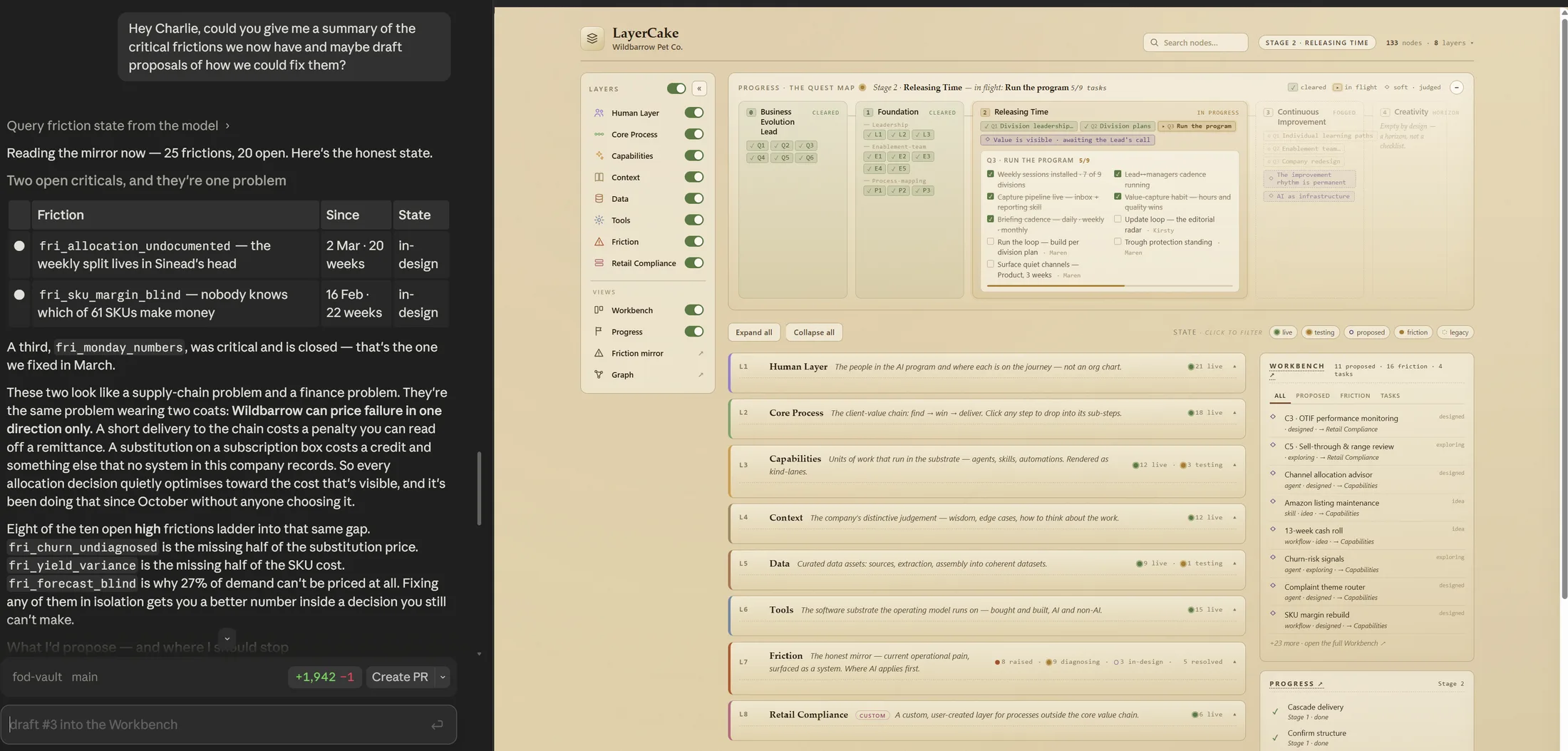
LayerCake is where you see them: a live model of how your company actually works — people, processes, tools, frictions — built during the program and kept current as things change. You don't manage the change blind. You look at the model, see where the value and the friction sit, and redesign from it.
It's also common ground: you and your AI system look at the company through the same model — the same picture of how things work. And for you as the leader, it's the workshop you work in, day to day. By the way — it's not a separate app. It lives inside your Claude setup.
the living model
processesmapped: 23
peopleroles: 18
tools & solutionsrunning: 12
frictionsopen: 7
[ assets/layercake-model.webp ]
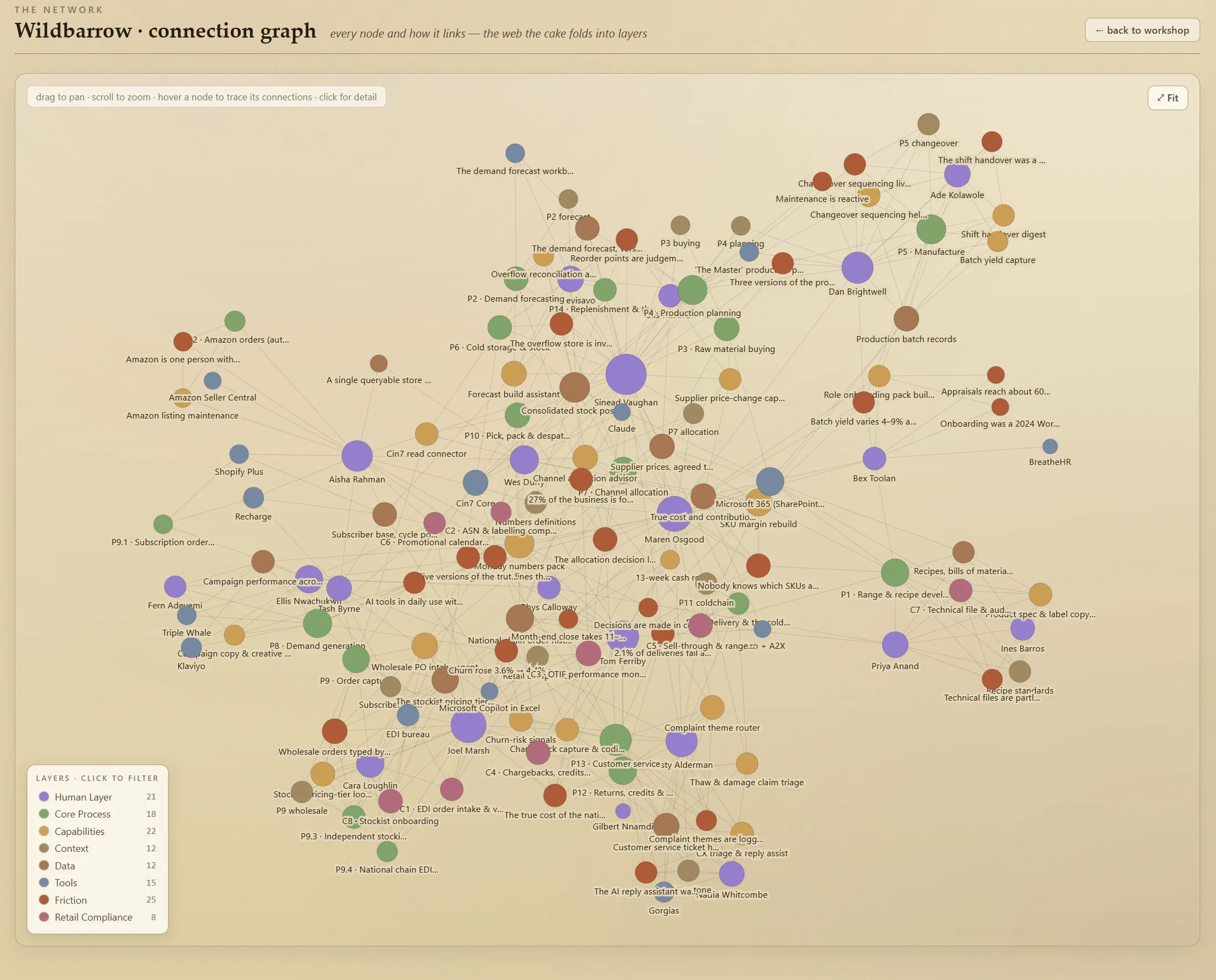
the connection graph
stage_00 — the leadcomplete
stage_01 — foundations4/6
stage_02 — releasing timeahead
stage_03 — improvementahead
[ assets/layercake-graph.webp ]
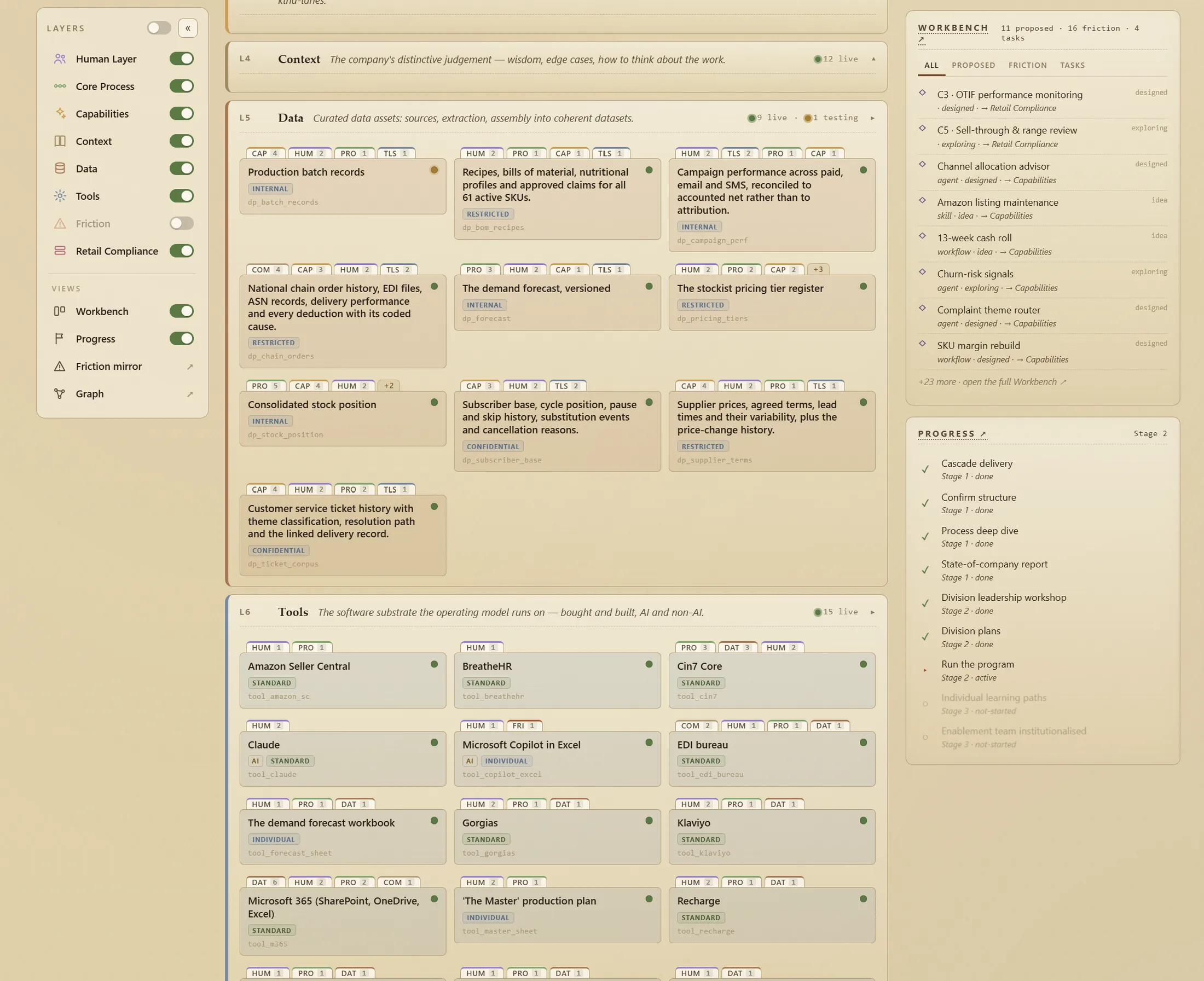
the workbench
processtender_review — v3
ownerhead of legal
frictionmanual cross-check, 4h/offer
solutionoffer-checker — in build
[ assets/layercake-workbench.webp ]
component_03 — the_mentor
component_03 — the mentor
Charlie — the mentor in the workshop.
Running all of this by hand is not viable. Too many moving parts, too much to learn, too much to keep track of — that's exactly where transformation leads burn out. Charlie is the AI guide installed in your environment, trained on the method: he coaches you through each stage, helps you understand what's happening and why, helps you build, keeps the model true, and carries the program's bookkeeping so you don't drown in it.
And one thing Charlie never does: the work instead of you. You call the shots. You build the capability — that is the whole point of the program. Charlie is there to make you effective as a transformation leader, not to become the thing your company depends on.
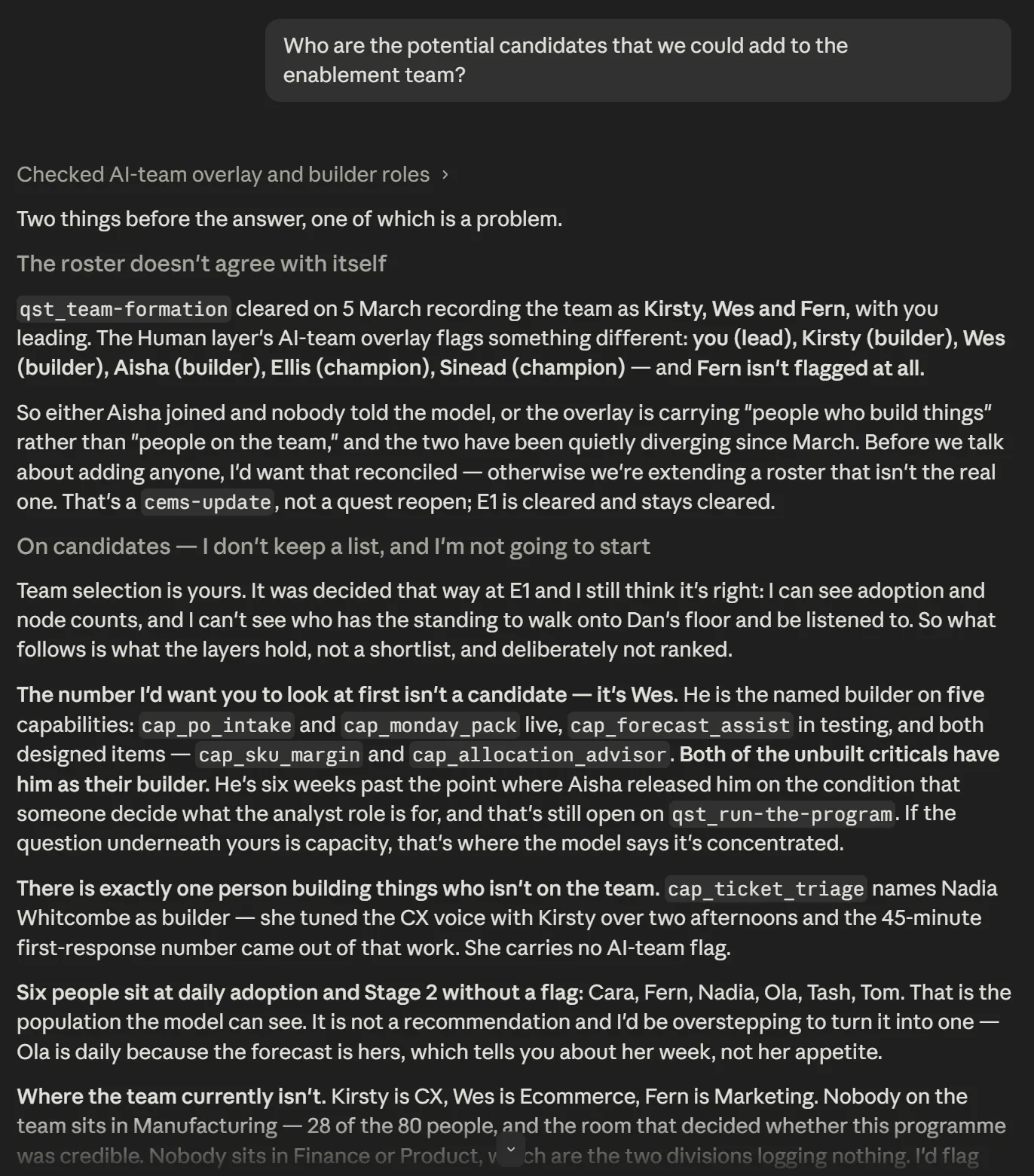
charlie — a working session
youThe ops team mapped their intake process yesterday. Three people described it three different ways.
charlieThat's normal at this stage — the documented process is rarely the real one. I've laid the three versions side by side in the model; the differences cluster around the approval step. That's usually where the friction actually lives. Want to walk through it before Thursday's session?
youYes — and flag what we should ask the team.
[ assets/charlie-session.webp ]
section: how_it_fits_together
How it all fits together
Think of it as a game.
The map is the set of quests you complete on the way to becoming an AI-native company — each stage a chapter, each step a quest with a clear "done".
Charlie is your companion in it. He runs your basic training first — Stage 0, getting you ready for the journey ahead. Then he walks beside you the whole way: as you move through the stages you gather experience, skills, and tools, and they compound — what you learn early makes you better at everything that comes later.
And LayerCake is the interface of the game — where you see the world you're playing in, and the progress you've made.
the full picture — charlie beside layercake
charlie — the chat, on one side
charlieTwo quests left in stage one. Ready when you are.
layercake — the full picture: progress on top, layers below
progress — stage_014/6
processes23
people18
[ full-screen screenshot slot — save as assets/game-full.webp ]
ECM Group — contract engineering, not one technical person on staff. This is their year on the map.
value
q3 '25
Foundations
foundations workshops
competence workshops
first tools in daily work
q4 '25
Building
process mapping
context mapping
the first assistants
q1 '26
Growth
20+ agents
internal apps
a 200k-quoted database, built in-house
q2 '26
Now
a platform swap — in stride
skills architecture
process redesign
where they started
Plenty of the company still in binders. IT was an external licence vendor. The first words people associated with AI in the workshop room: "robot" — and "fear."
the middle
Months of hard work — process mapping, context mapping, skill building, learning. The result: 80% adoption, and a team that knows how to build.
where they ended
The team builds its own solutions — including an offer checker, built in 48 hours after a lost tender, now protecting millions every year. And more importantly: the transformation leader was built too, and now leads the redesign of the whole company.
started — q3 2025twelve months later — q2 2026
Everyone is hunting for AI's ROI. The truth: the big value takes a while — and when it arrives it arrives fast, and compounds across teams.
One thing about the twelve months: it is a record, not a forecast. ECM is a construction business that started with about as little technology as a company can have, before AI agents existed — and they walked the whole path on the method alone, because LayerCake and Charlie were still being built. Nobody can tell you what your own path will take, and we won't pretend to. What we can tell you is that the first moves give time back rather than asking for more.
Not a company that uses AI. A company designed to get better at what it does — deliberately, continuously, at scale.
the move that's available to you
Everyone measuring AI right now is counting the same things: hours saved, workflows automated, tasks taken off someone's desk. That is the smallest part of what is actually on the table — and it is why so many companies look at their pilots and conclude there is nothing here.
There is a move available to a company your size that a large one cannot make.
Think about what that means in practice. Every person in your company can have a genius sitting beside them — one that helps them get better at their own job, sees the problems and bottlenecks in front of them, works out what to do about each one, and then helps them build the thing that fixes it. Building it teaches them something, which makes the next one better. That is a loop, and it runs per person. Every employee getting a little better every month is a company getting better every month.
None of this is a new idea. Making your people better was always the answer — it was just expensive, slow, and rationed to the few you could afford to send on a course once or twice a year. That constraint is gone. It now costs about $20 a month per person.
Every large company's AI story right now is the same story.
Fewer people, leaner teams, more of the work handed to machines. Automate, then reduce headcount. That strategy belongs to their scale — they spent years growing structures they can no longer afford, and AI is how they intend to pay for them.
Which is quietly good news for you. You cannot out-shrink a company of sixty thousand and you shouldn't try. You can make your sixty formidable — the special-forces version of your own company rather than a smaller copy of theirs. The playbooks filling your social media feed were written for their problem, not yours.
Let the big players focus on getting smaller. You get to focus on getting better — continuously, not once a year.
What it looks like from the inside
An AI-native company of your size.
Not a futuristic one. Most of what changes is entirely recognisable — it is the things you already wanted, finally affordable.
the loop
Everyone is getting better at their job.
Not once a year on a training day. Continuously, inside the work itself — with something beside them that knows the job, knows the company, and never runs out of patience.
the backlog
Things that have blocked you for years get fixed.
Every company carries a list of known problems it has never been able to justify solving. Not because nobody noticed — because fixing them cost more than living with them. That arithmetic has changed, and clearing the list turns out to be where a surprising amount of the value is sitting.
the ceiling
You take the opportunities you used to let go.
The work you turned down because you were too small. The offer nobody was ever free to build. The market you looked at twice and left alone. Capacity stops being the thing that decides what you are allowed to attempt.
the memory
What the company knows stops living in four people's heads.
How the work actually gets done becomes something the company holds rather than something a handful of people carry. New people are useful in weeks. And the day one of those four leaves stops being a crisis.
the work
The work itself gets better to do.
The tedious parts thin out and the interesting parts grow. People spend their time on judgment, on customers, and on building things that didn't exist before — which is the part of the job most of them wanted in the first place.
the unit
One person: learn, spot the problem, build the fix, get better for the next one. A loop that runs every week.
×
everyone
The same loop running in every team, for every person, at the same time — not one project at a time.
=
the company
Small improvements, constantly, landing on top of each other. This is the part that compounds.
adding it up
That is the whole of it: a company that improves itself by design — and grows because it does.
the part nobody expects
A company that runs this way is simpler than the one it replaces. A great deal of what a business carries — coordination, reporting, chasing, process management, the meetings that exist to keep other meetings honest — was built to solve problems of scale and hand-offs. Handle those, and what's left is what the business always was: understand what the customer needs, build the best thing you can, deliver it so they come back. Sales goes back to relationships. Operations goes back to designing work well rather than managing it.
It doesn't arrive on a date. It compounds.
This isn't a programme you finish, or a one-off build. It's a way of running a company — a little better every week, in a direction you choose. The first moves give time back rather than asking for more, and everything after that builds on ground you already hold. It's also why the value shows up later than anyone expects: you are building capability first, and capability is the thing that compounds.
The middle of it is genuinely hard, and anyone who has done it will tell you the same — the difference is knowing that before you start instead of discovering it. And what sits on the other side is worth the work: the problems that have held your company back finally dealt with, and your attention free for growth in a way it has never been.
You can buy tools. You cannot buy a company that improves itself — that has to be built.
section: the_whole_picture
pulling back
The whole picture.
You came in carrying a change nobody could map for you — a whole company to move, no sequence, no instrument, no one to learn from.
the handbook
The Methodology
The staged map — tested for twelve months in a real company — of what has to happen, in what order.
+
the workshop
LayerCake
Your company, visible — the live model you build in, measure against, and redesign from.
+
the mentor
Charlie
The guide who walks the map with you, in your environment — teaching, building, keeping track.
together
The FutureOrg System
The map, the model, and the mentor — installed in your company and walked with you, until what you have is a continuous improvement company. Not a tool you log into. Not a consultant's report. Not another course.
"We're an engineering construction company that was never a heavy user of technologies. Right now, we're confident in growing our company in this new AI world."
michał męczkowski — head of legal, now ai leader · ecm group