You've seen what AI can do. The question that keeps coming back isn't whether AI matters, it's why scaling it across your company is so much harder than anyone said it would be.
CEMS is the system that guides your company through its evolution into an AI-native organisation and gives you the tools to lead that evolution every day.
Apply for a pilot spot →You've used Claude. You've felt what it can do for your thinking, your decisions, your work. You've started spreading it across your team.
And somewhere along the way, three questions appeared that nobody had a good answer to:
How do I get everyone to actually start using it?
Once they do, how do we build this into a system we can see, understand, and keep improving?
And once AI takes over the routine work — what do people need to learn to use it creatively, to build the things that actually lead to growth?
These questions aren't about tools, but about your organisation. Scaling AI across a company is a completely different problem from learning to use it yourself because it's not about technology - it's about humans.
Nobody teaches the organisational part. Until now.
Consultants give you a plan, then leave. Online training builds awareness, but doesn't scale. Agencies build tools, but not the internal skills. No one gives you the tools and capabilities to do it yourself.
CEMS gives you all three, built into one system: a clear path through the AI-native evolution, the tools to do it at scale, and an AI guide trained on the methodology that supports your company every day 24/7.
Principles to design by, tools to design with,
and a master architect at your side.
Four stages, each building what the next one requires. You don't skip stages - not because of a rule, but because the foundation isn't there yet if you try. Every company starts at Stage I, regardless of how much AI they've already deployed.
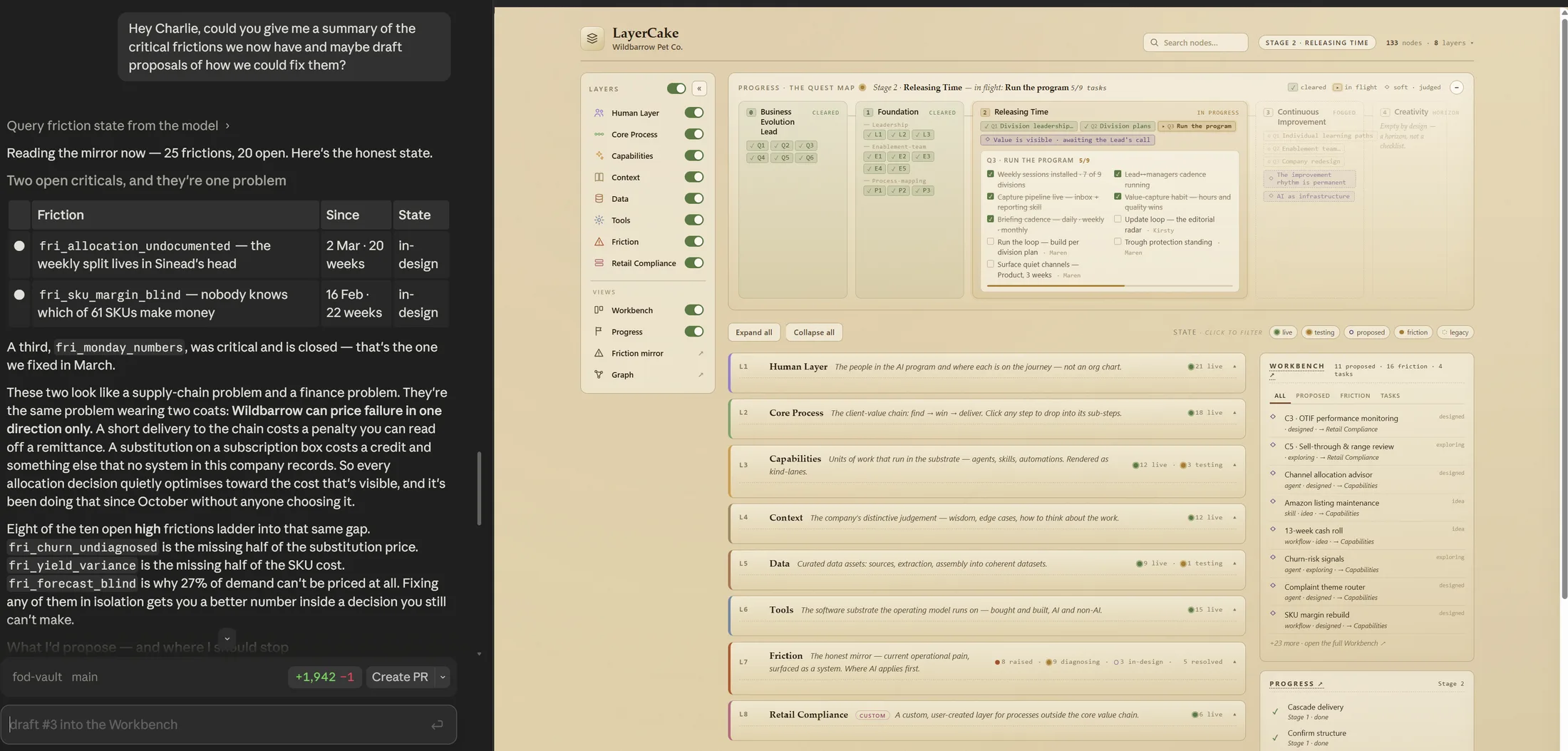
Map how your organisation actually works and evolves: your people, your processes, your tools, your context, your AI agents — across the layers that make up your business. This is where you see your company clearly, probably for the first time, and begin designing and rebuilding it deliberately.
It holds your company's context, knows your stage in the methodology, and works with you between sessions, not just during them. Not a chatbot. Not a generic assistant. A 24/7 AI transformation expert that knows your company.
We start with a discovery session: we map how your company operates, what you've tried with AI, where you're stuck. Then the real work begins: education, mapping your company layer by layer, forming your internal AI team, starting process mapping, setting up continuous improvement process loops.
By the end: your team has foundational AI capabilities, a shared understanding of the direction you're taking and a common goal. Your company and it's AI native evolution journey is mapped in Layer Cake OS. Your AI Transformation Lead has a clear plan and knows how to carry the evolution forward. The Guide is set up and working with your team every day. And all of it is interconnected into one system that feeds of itself.
After the eight weeks, we stay in contact. Monthly check-ins for three months, included. You're not left alone when things start to get interesting.
When the first workshop started, everyone in the room was asked the same question: what's your first association with AI? Every single person gave the same answer: Robot. No positive associations. One participant said it out loud: "We're just a bit afraid of it."
Six months later, that same team looked like this:
Here's what changed and how.
They started from the beginning. Shared knowledge, shared language, shared tools, foundations laid. The whole team learning together, not just the people who were already curious.
"I was the only person in the office who felt that way. I was even outraged when someone said they use AI for everything. By the end of the first workshop - the fear is still there, but so is curiosity."
— Workshop participant, Stage IThen the more advanced builds started. A personnel database: 3,500 documents processed, 1,000+ engineer profiles structured and searchable. Three weeks of work. Four years earlier, an external vendor had quoted the equivalent of €50,000 for something similar.
A fleet management application: built by a non-developer. Under €50 in total cost. Alternative to a system that would have cost over €10,000 to commission.
Then came the moment that said most about where this company had arrived. They lost a multi-million tender to a submission error. But this time, within 48 hours; without being asked, without any outside involvement; the team identified the problem and built an AI assistant to check every future offer before it goes out, saving millions in lost opportunity cost.
Nobody told them to. Nobody helped them. They just did it, because they knew it's possible.
"That's not just a company using AI tools. That's a company that has learned to solve its own problems and build new solutions using them."
In only a few months the entire team went from "we are scared of AI" to a shared continuous improvement mindset allowing them to fix issues they've known for years, identify growth opportunities and build solutions that will spur future growth.
CEMS is for the person leading AI adoption in their company. Whether that's the founder, a designated AI lead, or someone who simply stepped up and said "I'll figure this out" — if you're the one carrying this, this is for you.
You're not looking for another training day. Not an agency that builds something and disappears. Not a consultant who hands you a roadmap and wishes you luck.
You're looking for a system, a structure, tools and someone who has actually walked this path and can show you how to build the capability inside your company — so it stays there after we're done.
Early on I realised that the usual approaches — consultants, training, agencies — weren't going to be enough for AI adoption. Scaling AI across a company is a new kind of problem that needs new tools and solutions. So I spent two years building a system designed specifically for that problem, and spent the last ten months proving it works inside a real company.
Before FutureOrg, fifteen years in tech: growth strategies, operations, helping companies build things that scale.